Corporate Finance • Equity Valuation • Financial Modeling
DCF Valuation Models
Developed discounted cash flow valuation models for publicly traded companies using revenue forecasts, WACC estimation, terminal value analysis, and sensitivity testing.
Company 01
Procter & Gamble
NYSE: PG
Investment thesis
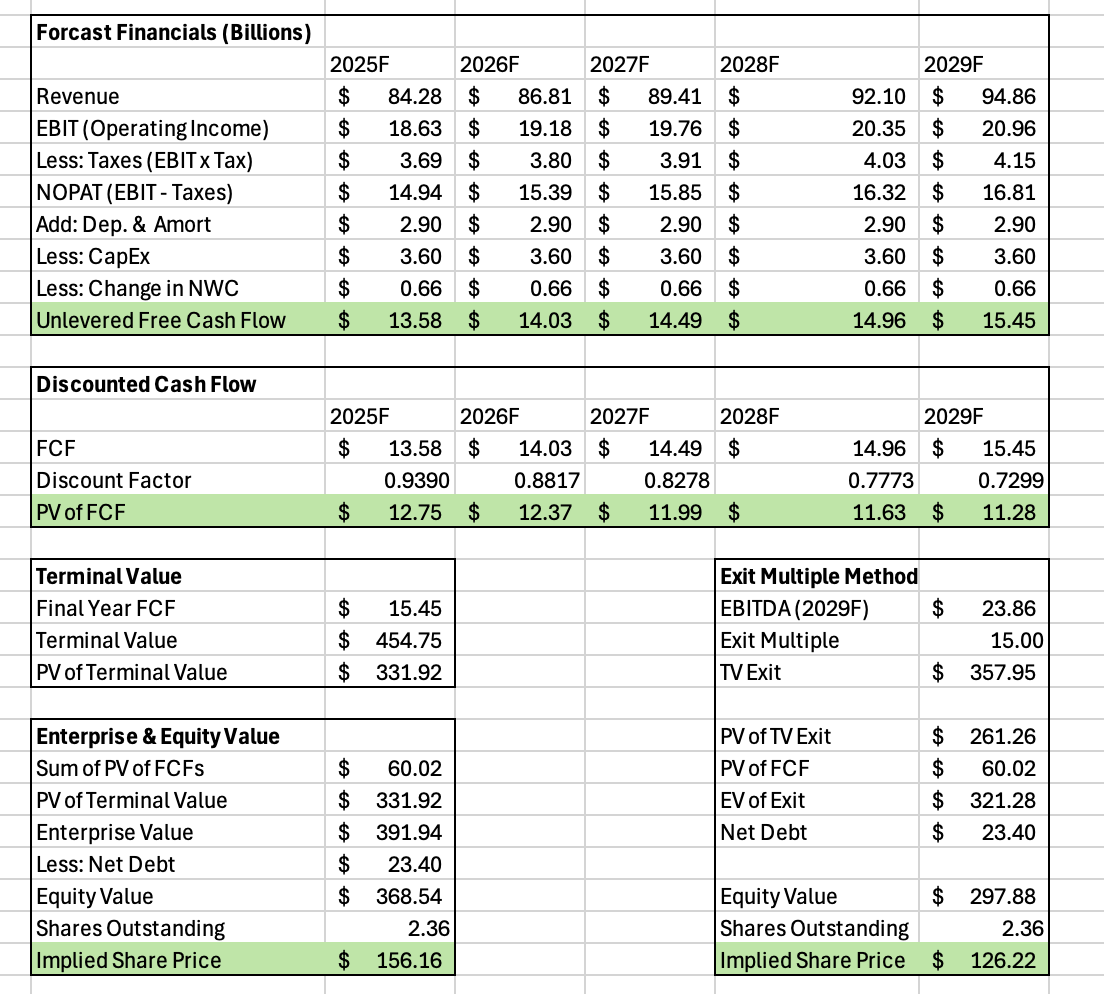
Procter & Gamble was selected as a mature consumer staples company with highly predictable cash flows, strong brand equity, and a long history of profitability. The valuation focused on determining whether the company's market price appropriately reflected its future free cash flow generation under conservative growth and margin assumptions.
Key assumptions
- 01Revenue was projected to grow from $84.3B to $94.9B over the forecast period, reflecting modest organic growth consistent with P&G's mature market position.
- 02Operating margins were maintained near historical levels at approximately 22%, supporting stable earnings and cash flow generation.
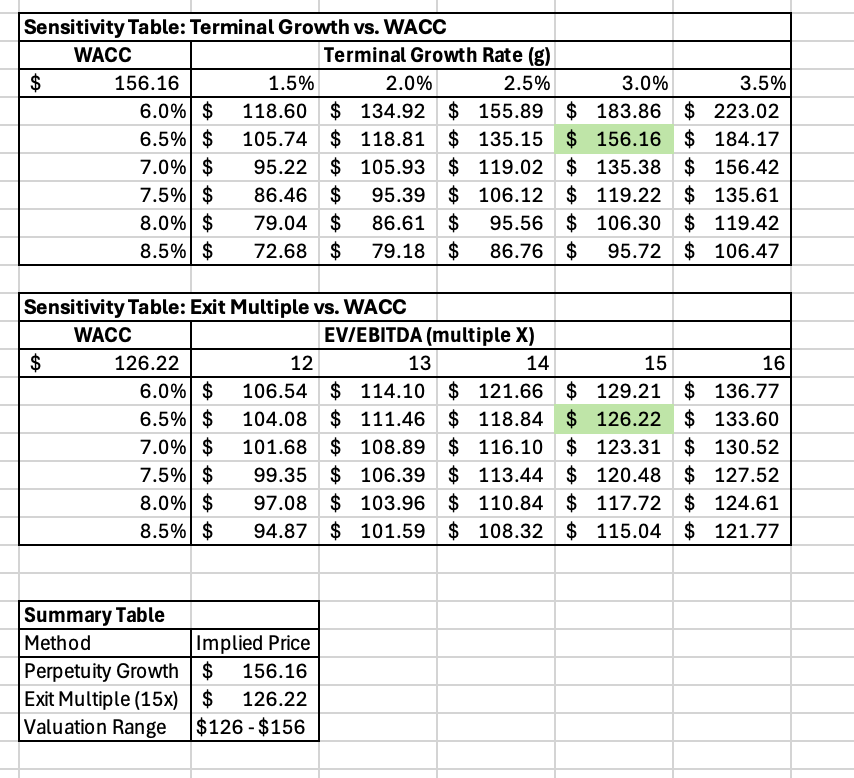
- 03A 6.5% WACC was derived using CAPM-based cost of equity, market risk assumptions, and P&G's capital structure.
- 04Terminal value was estimated using both a 3.0% perpetual growth rate and a 15.0x EBITDA exit multiple to establish a valuation range.
Valuation results
The model produced an implied equity value range of approximately $126 to $156 per share. Both valuation methodologies suggested that P&G was trading near intrinsic value, indicating limited valuation dislocation and reinforcing its profile as a stable, cash-generating business rather than a deep value opportunity.
Company 02
Uber Technologies
NYSE: UBER
Investment thesis
Uber has transitioned from a high-growth platform story into a cash-generating operating business. This valuation focuses on whether sustained growth in mobility and delivery, combined with improving operating leverage and free cash flow conversion, can justify the company's market valuation as profitability continues to mature.
Key assumptions
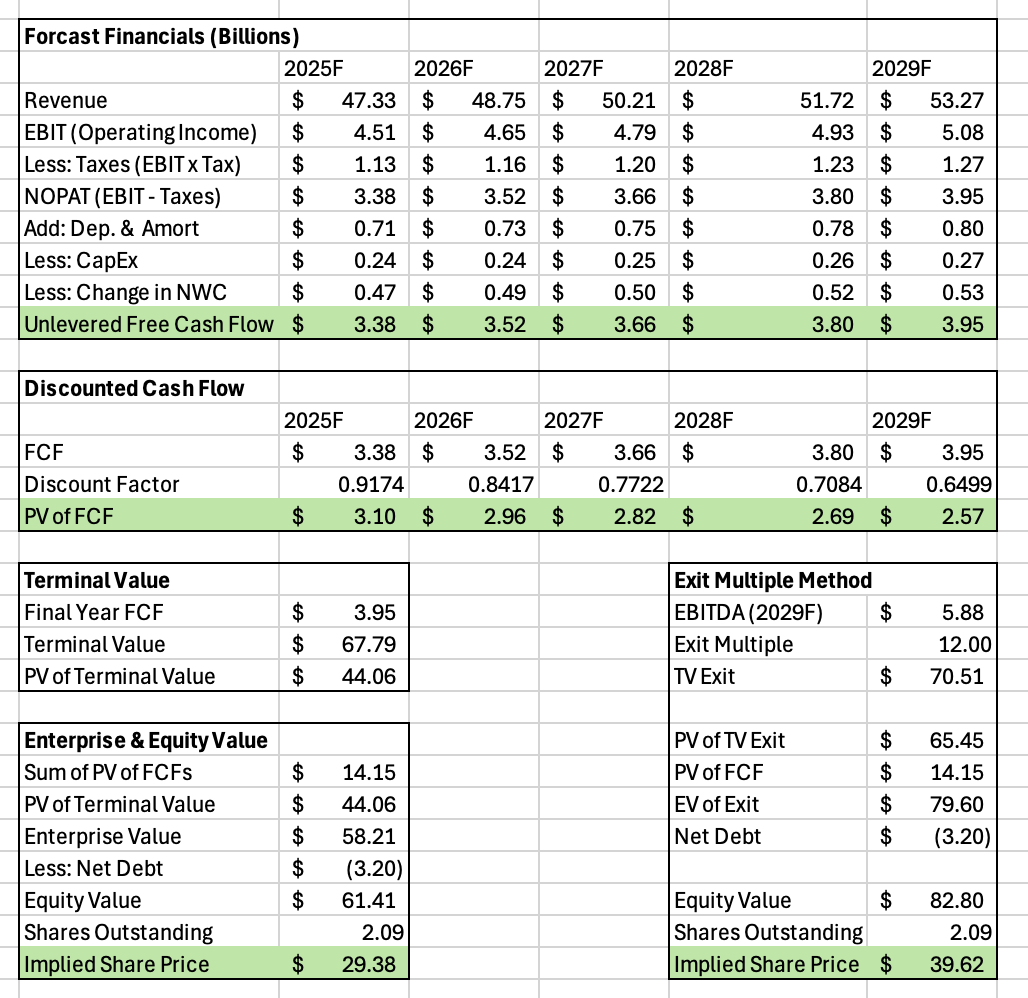
- 01Revenue grows from approximately $47.3B to $53.3B over the forecast period, reflecting continued expansion across mobility and delivery platforms.
- 02Operating income increases from $4.5B to $5.1B as scale efficiencies and disciplined cost management support margin expansion.
- 03Capital expenditures remain relatively modest while free cash flow grows from $3.4B to nearly $4.0B by the terminal year.
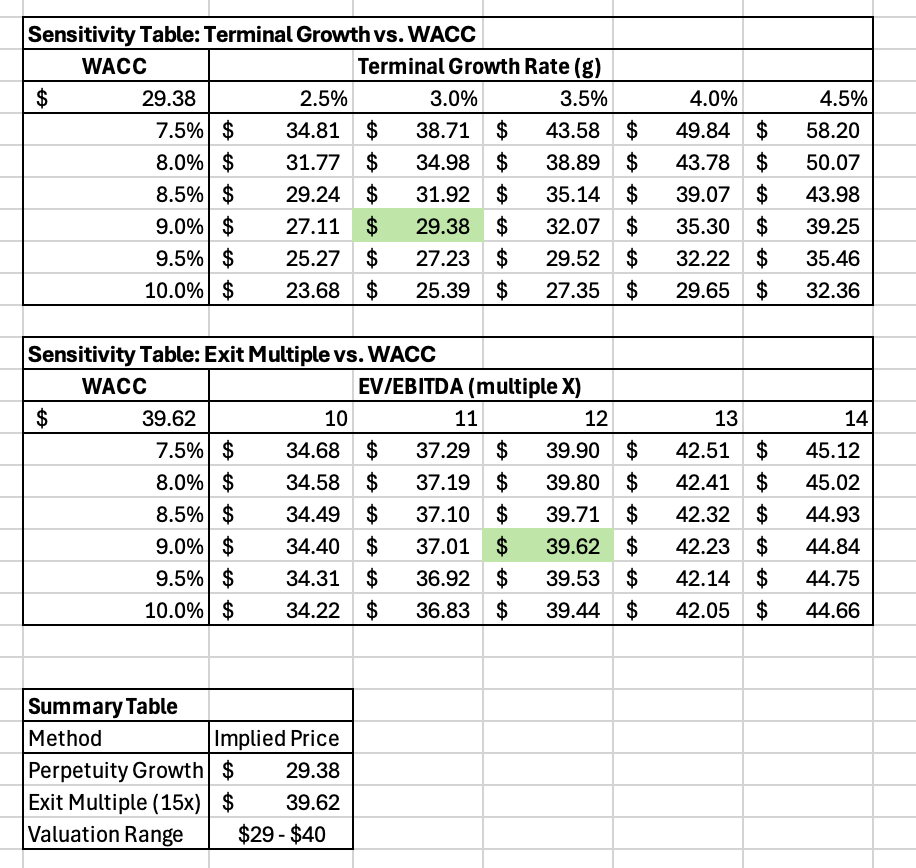
- 04Valuation is anchored on a 9.0% WACC and cross-checked using both perpetuity growth and a 12.0x EV/EBITDA exit multiple.
Valuation results
The valuation produced an implied equity value range of approximately $29-$40 per share. Results are highly sensitive to discount rate and terminal assumptions, illustrating how changes in long-term growth expectations can materially impact intrinsic value.
Company 03
Palantir Technologies
NYSE: PLTR
Investment thesis
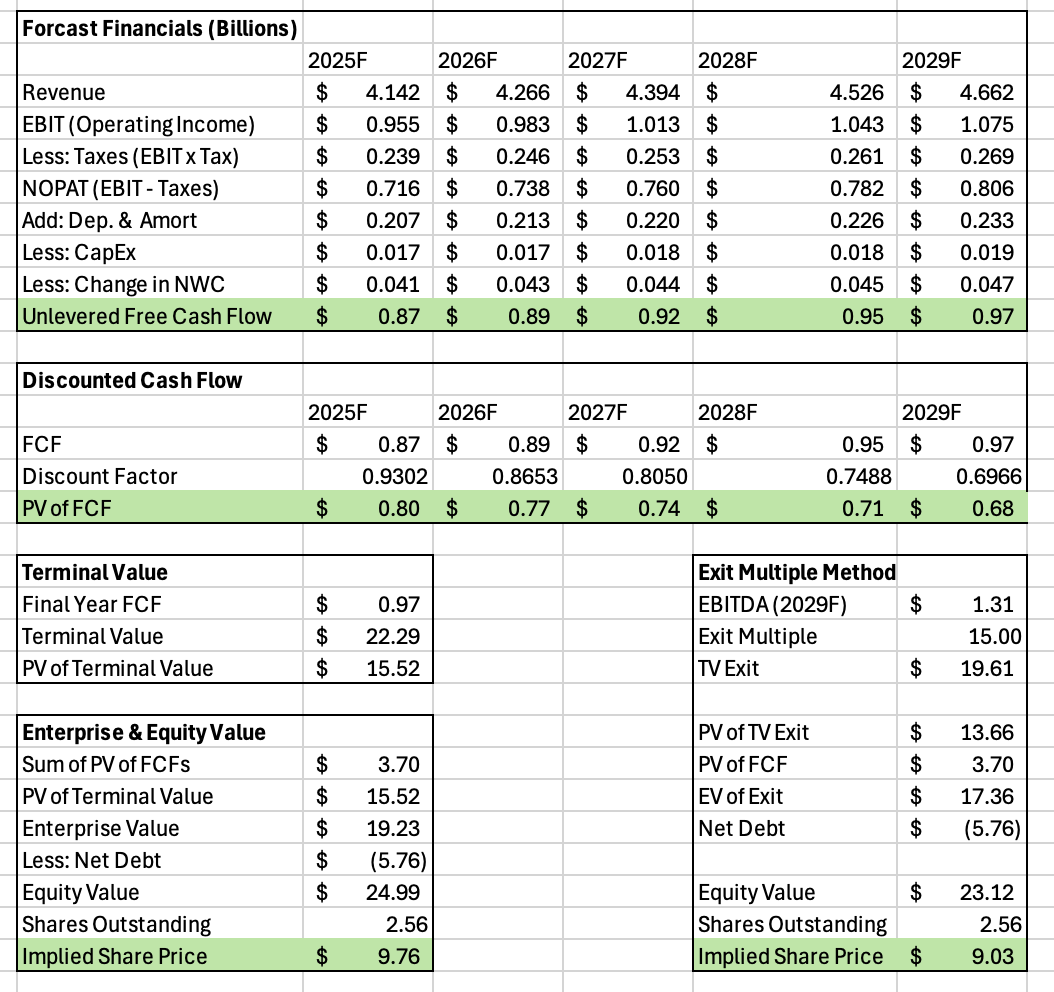
Palantir was selected as a high-growth software company experiencing accelerating commercial adoption alongside a large government customer base. The valuation focused on whether projected revenue growth, margin expansion, and free cash flow generation could justify the company's premium market valuation.
Key assumptions
- 01Commercial revenue growth materially outpacing government over the forecast period.
- 02Operating income growth is driven by continued revenue expansion while maintaining strong profitability and cash flow conversion.
- 03Stock-based compensation explicitly modeled and treated as a real economic cost.
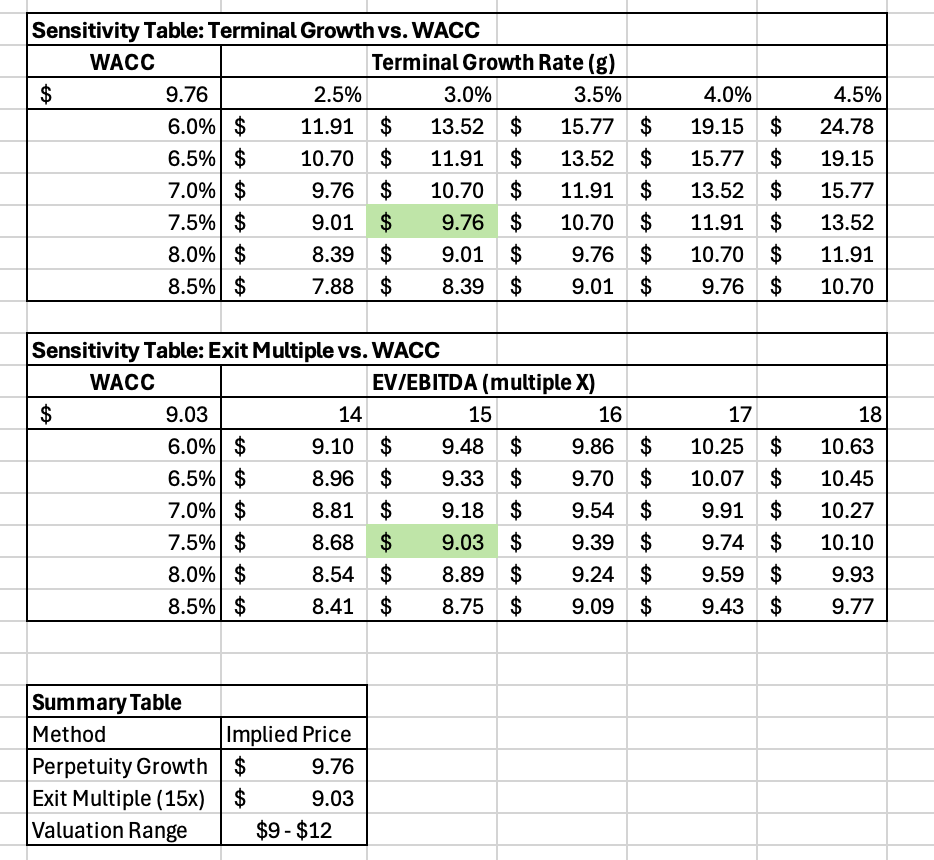
- 04Terminal value was estimated using both an EV/EBITDA exit multiple and perpetuity-growth methodology to establish a valuation range.
Valuation results
The model produced an implied equity value range of approximately $9-$12 per share. Under the base-case assumptions, both valuation methodologies resulted in values materially below the market price, indicating that investors are pricing in significantly higher growth, margin expansion, and monetization potential than reflected in the forecast.
What I learned
Valuation is a discipline of assumptions, not outputs
Building these models side-by-side reinforced that valuation is ultimately driven by assumptions rather than formulas. While the DCF framework remained consistent across Procter & Gamble, Uber, and Palantir, differences in growth expectations, profitability trajectories, capital intensity, and risk profiles produced dramatically different valuation outcomes. The exercise highlighted how small changes in key inputs such as WACC, terminal growth, and operating margins can materially impact intrinsic value. More importantly, sensitivity analysis shifted the focus away from identifying a single “correct” price target and toward understanding which assumptions drive value, where uncertainty exists, and what expectations are already embedded in the market price.
Skills demonstrated
- Excel
- Valuation
- Financial Modeling
- Forecasting
- Sensitivity Analysis